Futures Tick Size and Tick Value Cheat Sheet
Tick size and tick value for ES, MES, NQ, MNQ, YM, RTY, CL and GC, plus how to calculate P&L, size a stop in ticks and fit trades inside a drawdown.
By TickMint Team Published 6 min read Beginner
Key takeaways
- A tick is the smallest price move a contract can make, and the tick value is what that move is worth in dollars for one contract.
- Profit or loss equals ticks moved × tick value × number of contracts, before commissions and fees.
- Micro contracts are 1/10th the size of their full-size counterparts, so the same move is worth 1/10th as much.
- To size a stop, divide the dollars you're willing to lose by tick value × contracts to get a distance in ticks.
- Knowing tick values tells you how much room a prop firm drawdown really gives you on each contract.
On this page
- What are the tick sizes and tick values of popular futures?
- Where to check a contract’s tick size yourself
- What’s the difference between a tick and a point?
- How do you calculate futures profit and loss?
- Why are micro contracts 1/10th of the E-mini?
- How do you convert a dollar risk into a stop in ticks?
- Position size calculator
- What are the most common tick value mistakes?
- Mixing up points and ticks on NQ and ES
- Forgetting commissions and fees
- Ignoring slippage on stops
- How do tick values affect prop firm drawdown?
- Putting it together
A tick is the smallest price increment a futures contract can move, and the tick value is what one tick is worth in dollars for one contract. The E-mini S&P 500 (ES) moves in 0.25-point ticks worth $12.50. The E-mini Nasdaq-100 (NQ) also moves in 0.25-point ticks, but each one is worth $5.00. Crude oil (CL) ticks are $0.01 worth $10.00. Your profit or loss is always ticks moved × tick value × contracts.
What are the tick sizes and tick values of popular futures?
The table below covers the index, energy and metals contracts most day traders and prop firm traders use. Every value comes from the CME Group contract specification pages listed in the sources.
| Symbol | Contract | Exchange | Tick size | Tick value | Ticks per point | Point value |
|---|---|---|---|---|---|---|
| ES | E-mini S&P 500 | CME | 0.25 | $12.50 | 4 | $50.00 |
| MES | Micro E-mini S&P 500 | CME | 0.25 | $1.25 | 4 | $5.00 |
| NQ | E-mini Nasdaq-100 | CME | 0.25 | $5.00 | 4 | $20.00 |
| MNQ | Micro E-mini Nasdaq-100 | CME | 0.25 | $0.50 | 4 | $2.00 |
| YM | E-mini Dow ($5) | CBOT | 1 | $5.00 | 1 | $5.00 |
| MYM | Micro E-mini Dow | CBOT | 1 | $0.50 | 1 | $0.50 |
| RTY | E-mini Russell 2000 | CME | 0.1 | $5.00 | 10 | $50.00 |
| M2K | Micro E-mini Russell 2000 | CME | 0.1 | $0.50 | 10 | $5.00 |
| CL | Crude Oil (WTI) | NYMEX | 0.01 | $10.00 | 100 | $1,000.00 |
| MCL | Micro WTI Crude Oil | NYMEX | 0.01 | $1.00 | 100 | $100.00 |
| GC | Gold | COMEX | 0.1 | $10.00 | 10 | $100.00 |
| MGC | Micro Gold | COMEX | 0.1 | $1.00 | 10 | $10.00 |
A few things stand out:
- ES, NQ and their micros share the same tick size (0.25 points) but have very different tick values.
- YM moves in whole points. One tick on the E-mini Dow is 1.0 index point.
- CL and GC are quoted in dollars per unit. Crude ticks are one cent per barrel; gold ticks are 10 cents per troy ounce.
Where to check a contract’s tick size yourself
Every CME Group contract has a specifications page. The field to look for is Minimum Price Fluctuation, which gives the tick size and, for most contracts, its dollar value per contract. The Contract Unit field gives the multiplier, such as $50 × the S&P 500 Index for ES.
You can always rebuild the tick value from those two fields: tick size × multiplier. For ES that’s 0.25 × $50 = $12.50. For gold it’s $0.10 × 100 troy ounces = $10.00. Exchanges occasionally change specifications, so check the source page if a number looks different from what your platform shows.
What’s the difference between a tick and a point?
A point is a full one-unit move in the quoted price, for example ES going from 6,000.00 to 6,001.00. A tick is the minimum step the exchange allows inside that point.
How many ticks fit in a point depends on the contract:
| Contract | Ticks per point | Value of 1 point |
|---|---|---|
| ES | 4 | $50.00 |
| NQ | 4 | $20.00 |
| YM | 1 | $5.00 |
| RTY | 10 | $50.00 |
| CL | 100 | $1,000.00 |
| GC | 10 | $100.00 |
For crude and gold, traders rarely say “points”. A $1.00 move in CL is 100 ticks and is worth $1,000 per contract. A $1.00 move in gold is 10 ticks and is worth $100.
How do you calculate futures profit and loss?
The formula is the same for every contract:
P&L = ticks moved × tick value × number of contracts
To get ticks moved, divide the price difference by the tick size. Then subtract commissions and fees.
Why are micro contracts 1/10th of the E-mini?
Each micro contract in the table has a contract size 1/10th of its full-size counterpart, with the same tick size. MES is $5 × the S&P 500 Index against $50 for ES, and MCL is 100 barrels against 1,000 for CL. So every tick is worth 1/10th as much:
- ES $12.50 → MES $1.25
- NQ $5.00 → MNQ $0.50
- CL $10.00 → MCL $1.00
- GC $10.00 → MGC $1.00
That makes micros useful for learning, for fine-tuning size and for scaling in and out. Ten MES contracts carry the same dollar exposure per tick as one E-mini, although commissions are usually charged per contract, so ten micros typically cost more in fees than one E-mini.
How do you convert a dollar risk into a stop in ticks?
Turn the formula around. If you know how many dollars you’re prepared to lose on a trade, divide by tick value × contracts:
Stop distance in ticks = dollar risk ÷ (tick value × contracts)
You can also solve for contracts if your stop distance is set by the chart: contracts = dollar risk ÷ (stop in ticks × tick value). This is the core of position sizing.
Position size calculator
Use the calculator to check a trade before you place it. Pick a contract, enter your stop distance and contracts, and it shows the dollar value.
Tick value & position size calculator
Excludes commissions, fees and slippage. Stop orders can fill at a worse price than the stop in fast markets.
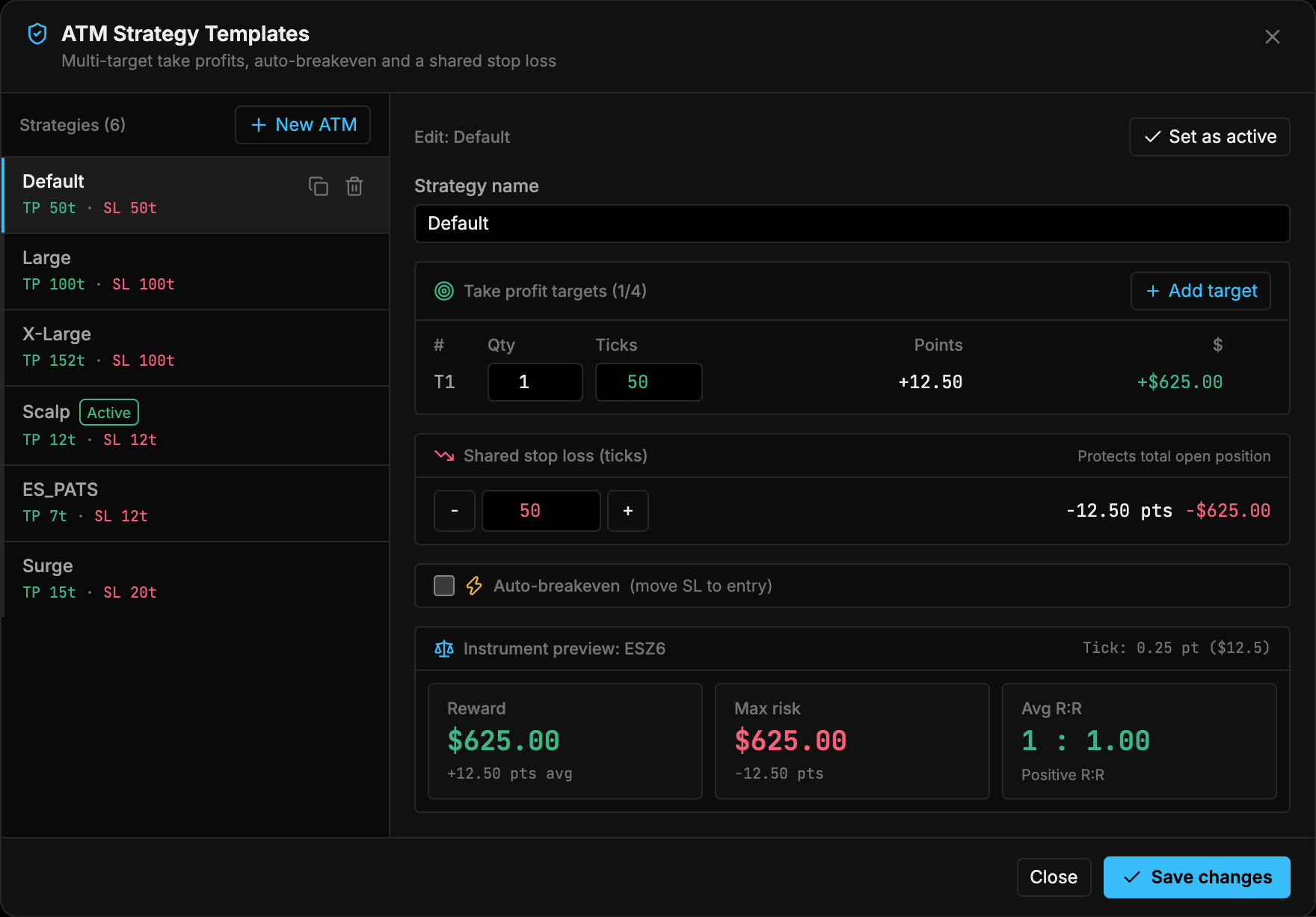
Many order entry screens do the same check automatically. A bracket order template set in ticks can show what that distance is worth on the current instrument.
What are the most common tick value mistakes?
Mixing up points and ticks on NQ and ES
Traders often say “ticks” when they mean “points”. On ES and NQ there are 4 ticks per point, so a “10-tick stop” and a “10-point stop” differ by a factor of four.
The contracts also differ from each other. A 10-point move is $500 on one ES but $200 on one NQ, because ES points are worth $50 and NQ points $20. NQ usually moves more points per day than ES, so a stop that looks small on an NQ chart in points can still cost more than you expect. Always convert to dollars before you enter.
Forgetting commissions and fees
The formula gives a gross figure. Every round turn also carries commissions, exchange and clearing fees, and sometimes platform or data fees per contract. These vary by broker and by firm, so check your own fee schedule.
Fees matter most on micros and on small targets. As a hypothetical example, if your all-in cost were $1.00 per MNQ round turn, that’s 2 ticks of MNQ before the trade earns anything. A 4-tick scalp would give half of its gross profit back in costs.
Ignoring slippage on stops
A stop order becomes a market order when it triggers, so it can fill worse than its price. That difference is slippage. It tends to be larger around news releases, at the open and in thin overnight markets.
If you plan for a 12-tick stop on CL and it fills 2 ticks lower, your loss is 14 ticks, or $140 instead of $120. Many traders add a tick or two of slippage when they size positions, especially on fast contracts.
How do tick values affect prop firm drawdown?
Prop firm evaluations give you a fixed dollar loss limit. Tick values tell you how much price movement that limit buys on each contract. If you’re new to evaluations, our futures prop firm trading guide covers the basics.
The type of drawdown changes how much of that room you actually have. A trailing drawdown follows your peak balance up, so open profits you give back can use up the limit even if the trade closes green. See trailing vs EOD vs static drawdown for how each one works. Rules vary between firms and change over time, so check your firm’s current rules.
Daily loss limits work the same way. If a hypothetical daily limit is $1,000, that’s 80 ticks (20 points) on one ES, but 800 ticks on one MES.
Putting it together
- Learn the tick size and tick value of every contract you trade, and keep the table handy.
- Convert every stop and target to dollars before you enter, and include fees and a little slippage.
- Size positions from your dollar risk, not from a fixed number of contracts.
- Check how many ticks your drawdown and daily loss limit allow on your contract and size.
For the wider picture of how intraday futures trading works, read how to day trade futures.
Frequently asked questions
What is the tick value of ES?
One E-mini S&P 500 (ES) contract has a tick size of 0.25 index points and a tick value of $12.50, so a full point is worth $50 per contract.
How much is one point on NQ worth?
The E-mini Nasdaq-100 (NQ) moves in 0.25-point ticks worth $5.00 each, so one point is 4 ticks and is worth $20 per contract. On the Micro (MNQ), one point is worth $2.
How do I calculate futures profit and loss?
Multiply the number of ticks the price moved by the tick value and by the number of contracts. Then subtract commissions and exchange fees to get your net result.
Are micro futures exactly 1/10th of the E-mini?
Yes for the contracts in this cheat sheet. MES, MNQ, MYM, M2K, MCL and MGC each have 1/10th the contract size of ES, NQ, YM, RTY, CL and GC, with the same tick size, so each tick is worth 1/10th as much.
How many ticks of NQ fit in a $2,500 drawdown?
At $5.00 per tick, $2,500 is 500 ticks, or 125 points, on one NQ contract before fees. With two contracts it halves to 250 ticks, and a trailing drawdown can shrink the room further as it follows your peak balance.
Sources
- CME Group: E-mini S&P 500 futures contract specs
- CME Group: Micro E-mini S&P 500 futures contract specs
- CME Group: E-mini Nasdaq-100 futures contract specs
- CME Group: Micro E-mini Nasdaq-100 futures contract specs
- CME Group: E-mini Dow ($5) futures contract specs
- CME Group: Micro E-mini Dow futures contract specs
- CME Group: E-mini Russell 2000 futures contract specs
- CME Group: Micro E-mini Russell 2000 futures contract specs
- CME Group: Light Sweet Crude Oil (WTI) futures contract specs
- CME Group: Micro WTI Crude Oil futures contract specs
- CME Group: Gold futures contract specs
- CME Group: Micro Gold futures contract specs