Futures Trading Hours and Sessions (RTH vs ETH)
CME Globex hours for ES, NQ, CL and GC, what RTH and ETH mean, the key times of the trading day in CT and ET, and how DST and holidays shift the schedule.
By TickMint Team Published 8 min read Beginner
Key takeaways
- CME Globex equity index, crude oil and gold futures trade Sunday to Friday, 5:00 p.m. to 4:00 p.m. CT, with a daily break from 4:00 to 5:00 p.m. CT.
- RTH for index futures matches the US stock market, 8:30 a.m. to 3:00 p.m. CT (9:30 a.m. to 4:00 p.m. ET); everything else is ETH, or the overnight session.
- Equity index futures settle at 3:00 p.m. CT but keep trading until 4:00 p.m. CT, so the settlement price and the last price are often different.
- The US and Europe change their clocks on different dates, so for a few weeks a year the gap between Chicago and European time is one hour shorter.
- Whether a chart uses RTH or the full session changes the session high and low, VWAP and volume profile.
On this page
- What are CME Globex trading hours?
- How energy and metals compare
- What is the difference between RTH and ETH?
- The day session and settlement aren’t the same thing
- What are the key times in the futures trading day?
- The overnight high and low
- Economic releases
- The open, midday and the close
- What are the initial balance and the opening range?
- How does daylight saving time affect futures hours?
- What about holidays?
- Why does the session setting change your indicators?
- Putting it together
CME Globex equity index futures such as ES and NQ trade from Sunday to Friday, 5:00 p.m. to 4:00 p.m. CT (6:00 p.m. to 5:00 p.m. ET), with a daily break from 4:00 to 5:00 p.m. CT. Crude oil (CL) and gold (GC) follow the same Globex schedule. Within that nearly 24-hour day, RTH (regular trading hours) for index futures matches the US stock market, 8:30 a.m. to 3:00 p.m. CT (9:30 a.m. to 4:00 p.m. ET). The rest is ETH, or the overnight session.
What are CME Globex trading hours?
CME Globex is CME Group’s electronic trading platform. For the contracts most day traders use, it runs as one long session per trading day:
- Opens: Sunday at 5:00 p.m. CT (6:00 p.m. ET) for the week.
- Daily break: Monday to Thursday, trading stops at 4:00 p.m. CT and reopens at 5:00 p.m. CT for the next trading day.
- Closes: Friday at 4:00 p.m. CT (5:00 p.m. ET).
A CME trading day starts the evening before its date. The session that opens at 5:00 p.m. CT on Tuesday is Wednesday’s trading day, and it ends at 4:00 p.m. CT on Wednesday.
How energy and metals compare
| Market | Globex hours (CT) | Daily break (CT) |
|---|---|---|
| Equity index (ES, MES, NQ, MNQ) | Sun–Fri, 5:00 p.m. – 4:00 p.m. | 4:00 – 5:00 p.m. |
| WTI crude oil (CL, MCL) | Sun–Fri, 5:00 p.m. – 4:00 p.m. | 4:00 – 5:00 p.m. |
| Gold (GC, MGC) | Sun–Fri, 5:00 p.m. – 4:00 p.m. | 4:00 – 5:00 p.m. |
The electronic hours line up, but the busy periods don’t. Crude oil and gold each have their own settlement times, set on their CME contract pages, and their most active hours are tied to their own markets and news rather than to the stock market open. CME Group can change hours, so confirm them on its trading hours page.
What is the difference between RTH and ETH?
For equity index futures, traders split the Globex day into two parts:
- RTH (regular trading hours): 8:30 a.m. to 3:00 p.m. CT (9:30 a.m. to 4:00 p.m. ET), the same hours as the US cash stock market. It’s usually the most active part of the day.
- ETH (extended trading hours): the full Globex session. Traders also use “ETH” or “overnight” for just the part outside RTH, from the 5:00 p.m. CT reopen to the 8:30 a.m. CT open.
RTH and ETH are trader and charting conventions, not separate markets. It’s the same order book all day. Overnight trading is often thinner, with wider spreads and a lighter order book, so the same order size can move price further.
The day session and settlement aren’t the same thing
RTH ends at 3:00 p.m. CT when the stock market closes, but equity index futures keep trading until 4:00 p.m. CT. The E-mini S&P 500 daily settlement price is set from Globex trading between 2:59:30 and 3:00:00 p.m. CT. That means:
- The settlement price is not the 4:00 p.m. CT last price.
- “Change on the day” on a quote screen is usually measured from the prior settlement, not from your chart’s close.
- Prop firms and brokers may use either time for their own rules, such as a daily cutoff or end-of-day drawdown. Check your firm’s definitions.
Settlement procedures differ by product and can change, so verify the current times on the CME contract page before you build rules around them.
What are the key times in the futures trading day?
| Time (CT) | Time (ET) | What happens |
|---|---|---|
| 5:00 p.m. | 6:00 p.m. | Globex reopens; new trading day starts |
| 5:00 p.m. – 8:30 a.m. | 6:00 p.m. – 9:30 a.m. | Overnight session; the overnight high and low form |
| 7:30 a.m. | 8:30 a.m. | Major US economic releases (such as jobs and CPI) |
| 8:30 a.m. | 9:30 a.m. | RTH open (US stock market open) |
| 8:30 – 9:30 a.m. | 9:30 – 10:30 a.m. | Initial balance (first hour of RTH) |
| about 11:00 a.m. – 1:00 p.m. | about 12:00 – 2:00 p.m. | Midday, often slower (a convention, not a rule) |
| 1:00 p.m. | 2:00 p.m. | Federal Reserve rate decisions, on FOMC days only |
| 3:00 p.m. | 4:00 p.m. | RTH close; ES daily settlement |
| 4:00 p.m. | 5:00 p.m. | Globex close and daily break |
The overnight high and low
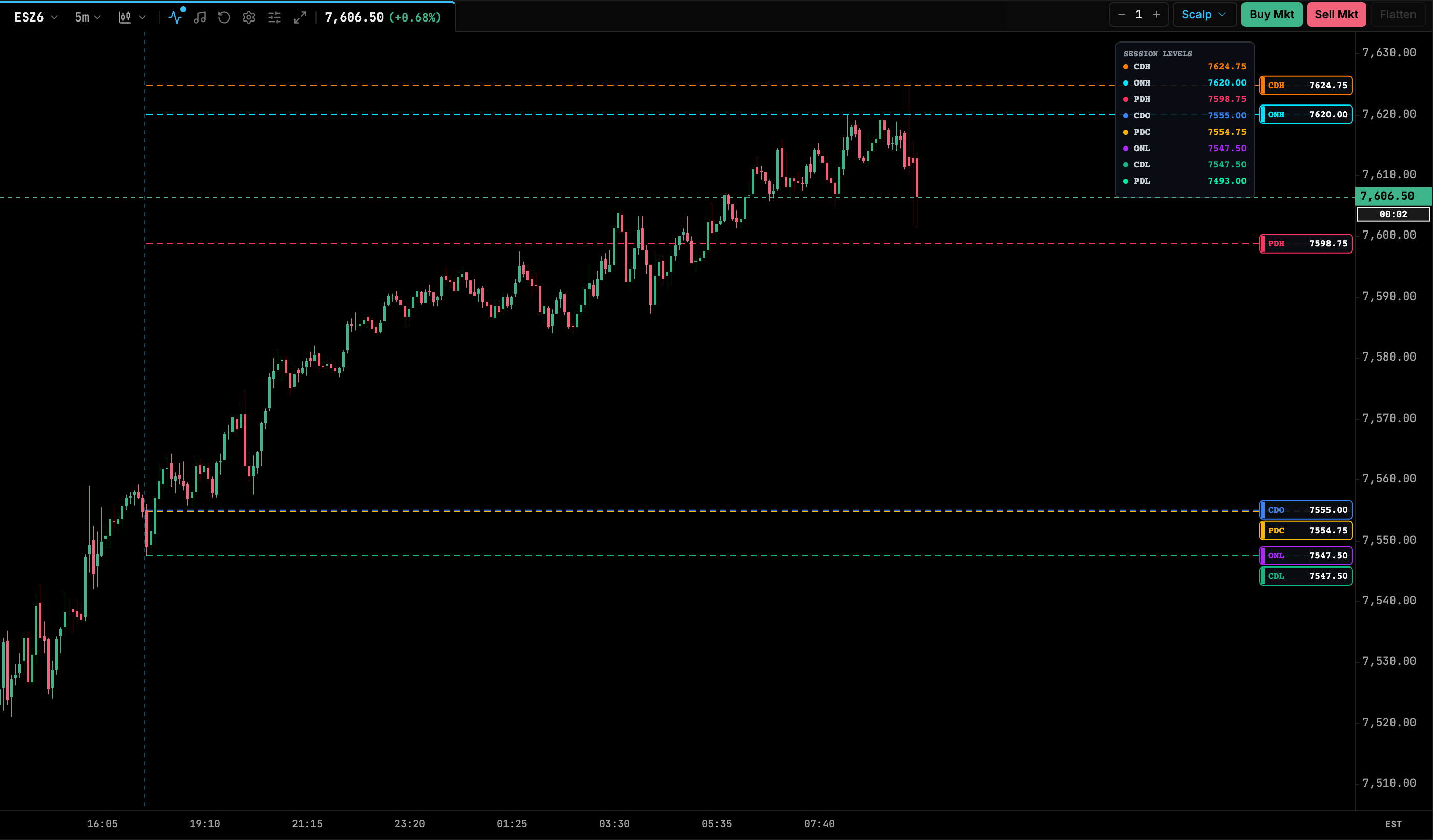
The overnight high and low are the highest and lowest prices traded between the 5:00 p.m. CT reopen and the 8:30 a.m. CT open. Many index traders mark them before the open, along with the prior day’s high, low and close, because the RTH session often reacts when price returns to them.
Economic releases
Major US government reports, such as the monthly jobs report and CPI, are released at 8:30 a.m. ET, which is 7:30 a.m. CT, an hour before the stock market opens. Index futures are already trading, so these releases often cause the biggest move of the overnight session. On FOMC days, the Federal Reserve’s statement comes out at 2:00 p.m. ET (1:00 p.m. CT), late in RTH. Check the calendar every morning.
The open, midday and the close
The first hour after 8:30 a.m. CT is usually the most active part of RTH, as stock market orders arrive. Many traders find midday slower and choppier, and activity often picks up again into the 3:00 p.m. CT close. These are tendencies, not rules, and news can change any of them on a given day.
What are the initial balance and the opening range?
The initial balance (IB) is the high and low of the first hour of RTH, 8:30 to 9:30 a.m. CT (9:30 to 10:30 a.m. ET). Market profile traders watch whether price breaks out of the IB later in the day, and how far, to judge whether the day is ranging or trending.
The opening range is the same idea over a shorter window, often the first 5, 15 or 30 minutes after the open. There’s no single standard length, so define yours and keep it consistent.
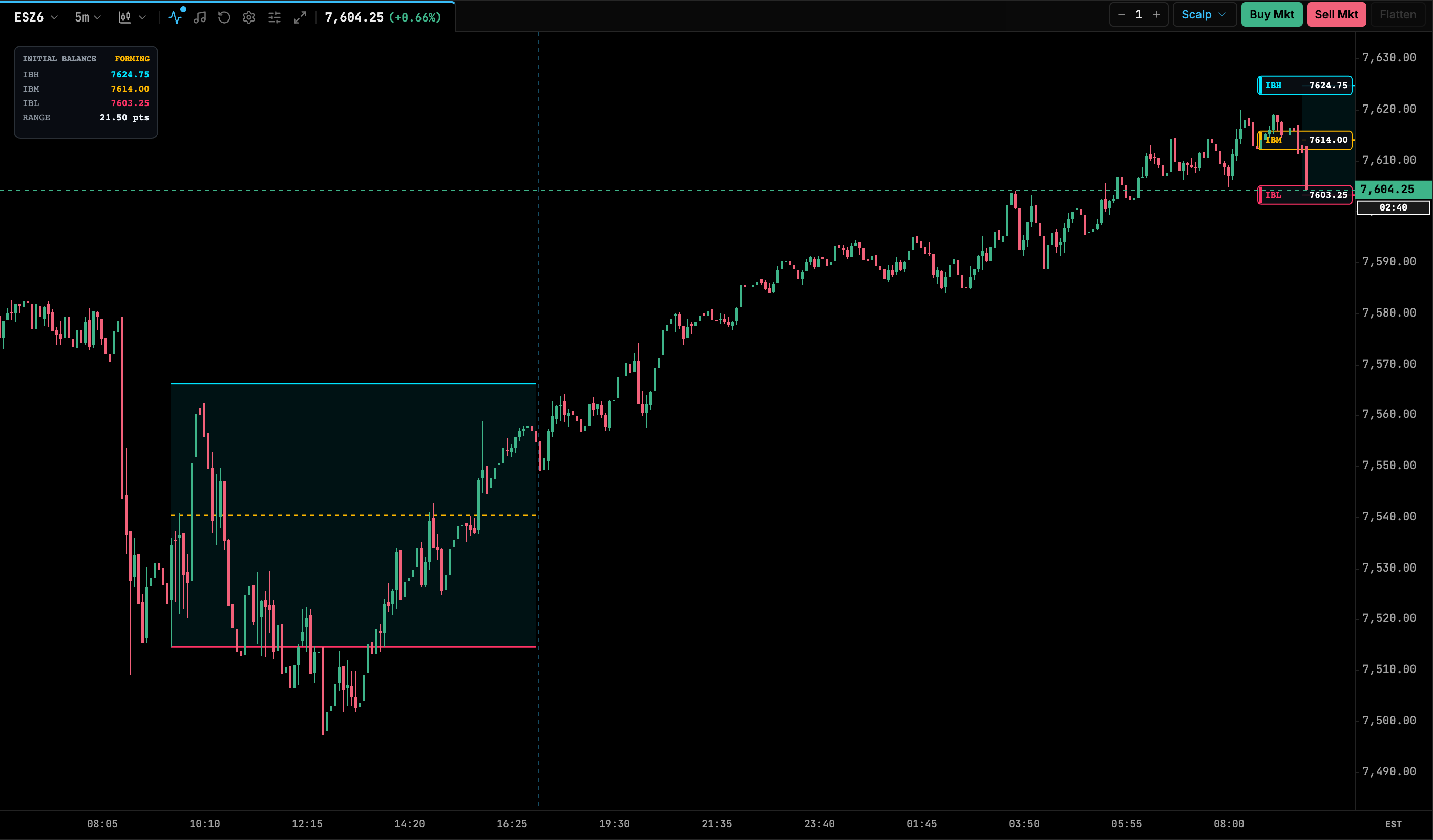
Both levels only make sense with an RTH definition. If your chart counted the overnight session as the start of the day, the “first hour” would be 5:00 to 6:00 p.m. CT the evening before.
How does daylight saving time affect futures hours?
CME hours are set in Chicago time, and Chicago and New York change their clocks on the same dates. So in CT and ET, the schedule above is the same all year.
If you trade from outside the US, it’s not that simple. The US starts daylight saving time on the second Sunday in March and ends it on the first Sunday in November. The European Union starts summer time on the last Sunday in March and ends it on the last Sunday in October. In the weeks between those dates, the gap between Chicago and Europe is one hour smaller than usual.
Two practical checks:
- Set your platform’s chart time zone to a named zone such as Chicago or New York, not a fixed UTC offset. A fixed offset won’t follow US clock changes, so session-based indicators can drift by an hour.
- Recheck any alarms, alerts or time-based rules in your trading plan in the weeks around the clock changes.
What about holidays?
On US market holidays, CME Globex often has shortened hours or an early close rather than a full closure, and the schedule differs between product groups. A trading day can also be cut short the day before or after a holiday, which can affect settlement times and your firm’s daily rules.
CME Group publishes the schedule for each holiday on its holiday calendar. Check it at the start of every holiday week, and check whether your broker or prop firm has its own rules for those days.
Why does the session setting change your indicators?
Any indicator that resets each day depends on when your platform thinks the day starts. With an ETH (full session) setting, the day starts at 5:00 p.m. CT the evening before. With an RTH setting, it starts at 8:30 a.m. CT. The same chart can show different values depending on that choice:
- Session high and low. An ETH session includes the overnight range, so its high and low can be well away from the RTH high and low.
- VWAP. VWAP averages price weighted by volume from the session start. An ETH VWAP includes overnight trades; an RTH VWAP starts fresh at the open. The two lines can sit several points apart.
- Volume profile. A daily profile built from the full session includes overnight volume, which can move the point of control and value area compared with an RTH-only profile. See volume profile explained.
- Prior-day levels. The prior day’s high, low and close differ between RTH and ETH definitions. The RTH close is typically taken at 3:00 p.m. CT, while the ETH session ends at 4:00 p.m. CT.
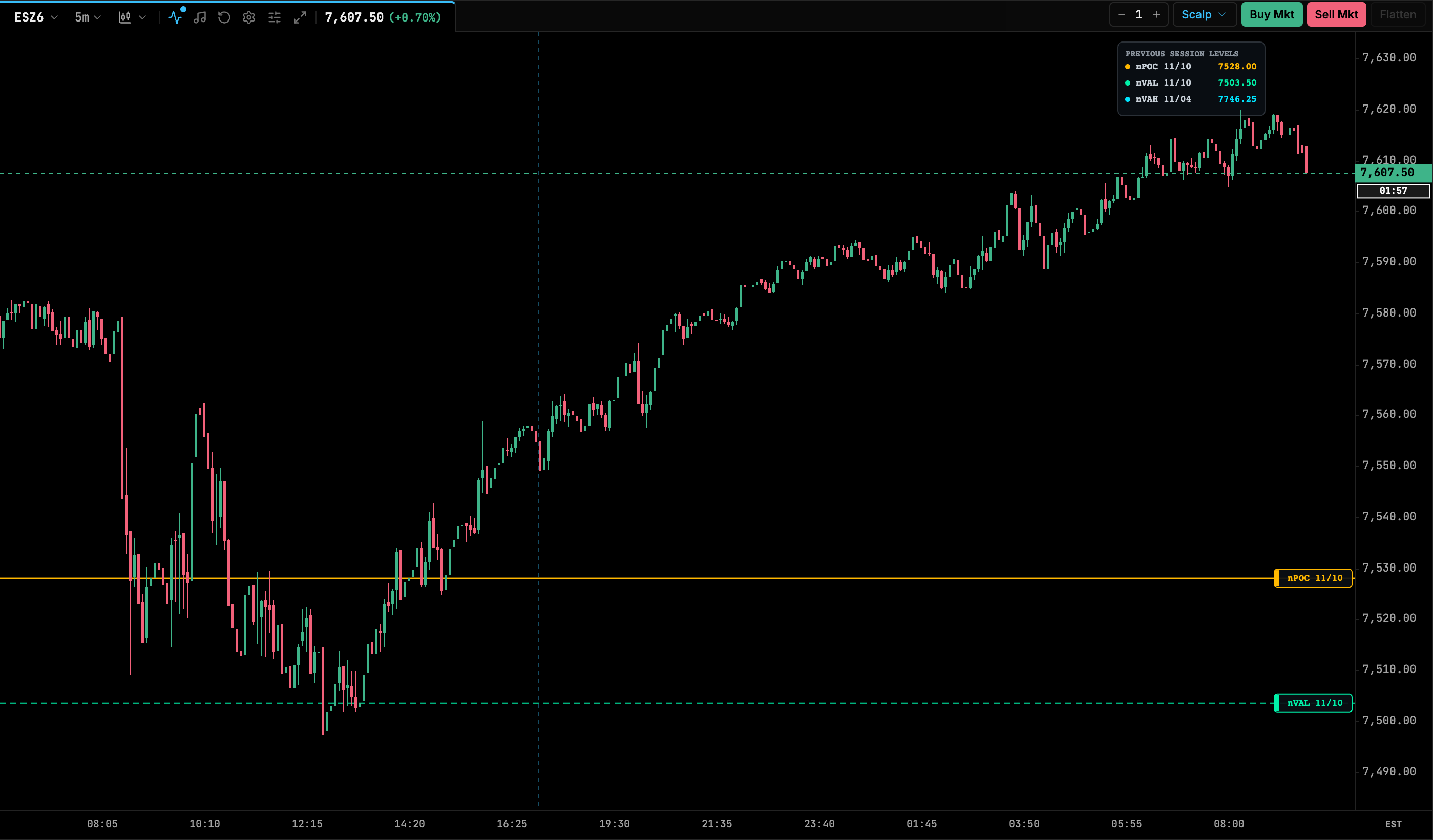
Neither setting is right or wrong. Many index traders use RTH for levels tied to the stock market open, and ETH when overnight trading matters, as it often does in crude oil and gold. What matters is knowing which one your chart uses and using the same setting when you compare notes with other traders.
Putting it together
- Learn the Globex schedule: Sunday to Friday, 5:00 p.m. to 4:00 p.m. CT, with a 4:00 to 5:00 p.m. CT break.
- Know where RTH sits (8:30 a.m. to 3:00 p.m. CT) and that ES settles at 3:00 p.m. CT but trades until 4:00 p.m. CT.
- Mark the overnight high and low and check the 7:30 a.m. CT (8:30 a.m. ET) releases before the open.
- Decide whether your indicators use RTH or ETH, and keep that setting consistent.
- Recheck times around daylight saving changes and holidays.
For how these times fit into a full trading routine, read how to day trade futures. For setups built around the open, the initial balance and the overnight range, see futures day trading strategies. Futures trading involves substantial risk of loss.
Frequently asked questions
What are ES futures trading hours?
E-mini S&P 500 futures trade on CME Globex from Sunday to Friday, 5:00 p.m. to 4:00 p.m. CT (6:00 p.m. to 5:00 p.m. ET), with a daily one-hour break from 4:00 to 5:00 p.m. CT. Always check CME Group's site for holiday changes.
What is the difference between RTH and ETH?
RTH, or regular trading hours, is the part of the day that matches the US stock market, 8:30 a.m. to 3:00 p.m. CT. ETH, or extended trading hours, is the full Globex session, including the overnight hours outside RTH.
What time do futures settle?
It depends on the contract. E-mini S&P 500 futures settle at 3:00 p.m. CT, based on trading in the 30 seconds before then, while trading continues until 4:00 p.m. CT. Energy and metals contracts have their own settlement times, so check each contract's page on CME Group.
Do futures trading hours change with daylight saving time?
CME hours are set in Chicago time, so they stay the same in CT and ET all year. If you live outside the US, the local time of the open can shift by an hour, especially in the weeks when the US and Europe are out of sync.
Sources
- CME Group: Trading hours
- CME Group: E-mini S&P 500 futures contract specs
- CME Group: Micro E-mini Nasdaq-100 futures contract specs
- CME Group: Light Sweet Crude Oil (WTI) futures contract specs
- CME Group: Gold futures contract specs
- CME Group: Holiday calendar
- U.S. Bureau of Labor Statistics: Release calendar
- Federal Reserve: FOMC meeting calendars and statements
- NIST: Daylight saving time
- EUR-Lex: Directive 2000/84/EC on summer-time arrangements