Day Trading Futures · Complete guide
How to Day Trade Futures: A Beginner's Guide
A plain-English guide to day trading futures: picking a market, contract specs, accounts, platforms, order types, risk per trade and a simple daily routine.
By TickMint Team Published 13 min read Beginner
Key takeaways
- Day trading futures means opening and closing positions within the same session, usually in liquid CME Group contracts such as the equity index micros.
- Learn the contract before you trade it: tick size, tick value, trading hours and which contract month is the front month.
- Futures are leveraged, so a small price move can mean a large gain or loss, and you can lose more than you deposit.
- Size every trade from your stop distance and the tick value, and set a daily loss limit before the session starts.
- Practice on a simulator or market replay and keep a journal before you put real money or an evaluation fee at risk.
On this page
- What are futures, and why do day traders use them?
- Which futures market should a beginner day trade?
- E-mini and Micro E-mini S&P 500 (ES, MES)
- E-mini and Micro E-mini Nasdaq-100 (NQ, MNQ)
- Crude oil (CL, MCL)
- Gold (GC, MGC)
- How do ticks, tick values and contract months work?
- Ticks and their dollar value
- Contract months and symbols
- Rollover
- Do you need a broker account or a prop firm evaluation?
- Retail broker accounts
- Prop firm evaluations
- What platform and market data do you need?
- Level 1 vs Level 2 data
- The DOM
- Charts
- What order types do futures day traders use?
- What does a simple day trading routine look like?
- Before the session
- During the session
- After the session
- How do you manage risk as a futures day trader?
- Risk per trade
- Daily loss limit
- Position sizing with tick value
- How should you practice before trading real money?
- Simulator trading
- Market replay
- Keep a trading journal
- What are the most common beginner mistakes?
- Putting it together
Day trading futures means buying and selling futures contracts and closing every position before the session ends, so you hold nothing overnight. Most day traders use liquid CME Group contracts such as the Micro E-mini S&P 500 (MES) or Micro E-mini Nasdaq-100 (MNQ). To start, you need to understand one contract well, open a broker account or a prop firm evaluation, use a platform with real-time data, and trade a written plan with a fixed risk per trade. Futures use leverage and involve substantial risk of loss, including losses larger than your deposit.
This guide walks through each step in order. It’s educational, not advice, and it doesn’t tell you what to trade or how much to risk.
What are futures, and why do day traders use them?
A futures contract is a standardized agreement to buy or sell an asset at a set price on a future date. The exchange sets the size of each contract, the smallest price move and the expiration dates, so every contract in a market is identical. Day traders rarely care about the delivery part. They close their position long before expiration and only care about the price change while they hold it.
Futures appeal to day traders for a few practical reasons:
- Leverage. You post a margin deposit that is a small fraction of the contract’s full value. A small move in price is a large move relative to that deposit, in both directions.
- Nearly 24-hour access. The CME Globex equity index, energy and metals markets trade from Sunday evening to Friday afternoon US Central Time, with a daily one-hour break. See futures trading hours and sessions for the exact times.
- A central exchange. Every order for a CME contract goes to the same order book, so the price, volume and depth you see come from one place.
- Going short is as simple as going long. You sell first and buy back later, with no borrowing step.
- Tax treatment differs by country and personal situation. We don’t give tax advice; ask a qualified tax professional where you live.
Which futures market should a beginner day trade?
Most futures day traders focus on one or two markets and learn how they move. The four most common choices are below. The micro contracts are 1/10th the size of the full-size contracts, with the same tick size, so each tick is worth 1/10th as much.
| Symbol | Contract | Exchange | Tick size | Tick value | Ticks per point | Point value |
|---|---|---|---|---|---|---|
| ES | E-mini S&P 500 | CME | 0.25 | $12.50 | 4 | $50.00 |
| MES | Micro E-mini S&P 500 | CME | 0.25 | $1.25 | 4 | $5.00 |
| NQ | E-mini Nasdaq-100 | CME | 0.25 | $5.00 | 4 | $20.00 |
| MNQ | Micro E-mini Nasdaq-100 | CME | 0.25 | $0.50 | 4 | $2.00 |
| CL | Crude Oil (WTI) | NYMEX | 0.01 | $10.00 | 100 | $1,000.00 |
| MCL | Micro WTI Crude Oil | NYMEX | 0.01 | $1.00 | 100 | $100.00 |
| GC | Gold | COMEX | 0.1 | $10.00 | 10 | $100.00 |
| MGC | Micro Gold | COMEX | 0.1 | $1.00 | 10 | $10.00 |
E-mini and Micro E-mini S&P 500 (ES, MES)
The S&P 500 futures track 500 large US companies. ES is $50 × the index and MES is $5 × the index, both with a 0.25-point tick. They’re heavily traded, and the order book is usually deep. Many traders find ES moves in a steadier, more orderly way than the Nasdaq contracts.
E-mini and Micro E-mini Nasdaq-100 (NQ, MNQ)
The Nasdaq-100 futures track 100 large non-financial Nasdaq companies, weighted toward technology. NQ is $20 × the index and MNQ is $2 × the index, with a 0.25-point tick. The index level is much higher than the S&P 500’s, so NQ usually moves more points in a day, and fast moves are common. That makes stop placement and sizing more demanding.
Crude oil (CL, MCL)
WTI crude oil futures trade on NYMEX. CL is 1,000 barrels with a $0.01 tick worth $10.00. MCL is 100 barrels, so the same tick is worth $1.00. Crude reacts strongly to supply news, inventory reports and geopolitics, and it can move sharply in seconds.
Gold (GC, MGC)
Gold futures trade on COMEX. GC is 100 troy ounces with a $0.10 tick worth $10.00, and Micro Gold is 10 troy ounces, so its tick is worth $1.00. Gold often reacts to interest-rate expectations, the US dollar and risk sentiment.
How do ticks, tick values and contract months work?
Ticks and their dollar value
A tick is the smallest price move a contract can make. The tick value is what that move is worth in dollars for one contract. For MES, the tick is 0.25 index points and each tick is worth $1.25, so one full point (4 ticks) is worth $5.00. Every P&L calculation in futures follows one formula:
P&L = ticks moved × tick value × number of contracts, before commissions and fees.
The futures tick size and tick value cheat sheet lists the values for the common contracts and has more worked examples.
Contract months and symbols
Futures have expiration dates, and each contract month is a separate instrument. The symbol combines the product code, a month letter and the year. Equity index futures such as ES, MES, NQ and MNQ list quarterly contracts: March (H), June (M), September (U) and December (Z). So MESZ6 is the Micro E-mini S&P 500 December 2026 contract. Equity index futures stop trading at 9:30 a.m. ET (8:30 a.m. CT) on the third Friday of the contract month. Crude oil lists a contract for every month, and gold lists several active months, each with its own last trading day on the CME spec page.
Rollover
Day traders trade the front month: the contract with the most volume and the tightest market. As expiration nears, traders move to the next contract month. This is called rollover. For equity index futures, volume usually shifts to the next quarterly contract in the week or so before expiration, and CME Group publishes the customary roll dates. After the roll, the old contract gets thin, so check that your chart and your order ticket both show the new month.
Do you need a broker account or a prop firm evaluation?
You have two main routes into futures day trading, and each comes with its own costs and rules.
| Retail broker account | Prop firm evaluation | |
|---|---|---|
| Whose money | Yours | The firm’s, after you pass |
| Upfront cost | Your deposit | An evaluation fee (often monthly) |
| Maximum loss | Your account balance, and possibly more | Usually the fee, but check the terms |
| Rules | Broker margin and risk rules | Profit target, drawdown, daily loss and other firm rules |
| Profits | All yours, after costs | Shared under the firm’s payout terms |
Retail broker accounts
A futures broker (in the US, a firm registered as a futures commission merchant or an introducing broker) holds your money and routes your orders to the exchange. CME Clearing sets the initial and maintenance margin needed to hold a position overnight. Margin isn’t a down payment or a loan; it’s a good-faith deposit, and CME raises it when markets get more volatile. Brokers can require more than the exchange minimum but not less for overnight positions.
Many brokers also offer lower day trading margin for positions opened and closed within the session. That rate is set by the broker, not by the exchange, and it applies only until the broker’s cutoff time, usually shortly before the daily close. If you still hold a position after the cutoff, the full overnight margin applies, and the broker may close the position for you. Ask your broker for its exact rates and cutoff.
Low day trading margin doesn’t mean a trade is low risk. It means more leverage is available.
Prop firm evaluations
A prop firm evaluation is a trial account. You pay a fee, trade a simulated or live account under the firm’s rules and, if you hit the profit target without breaking a rule, you may get a funded account. A typical hypothetical setup is a $50,000 evaluation with a $2,500 trailing drawdown, a daily loss limit and a minimum number of trading days. Rules vary widely between firms and change often, so read your firm’s current rules before you trade.
The futures prop firm trading guide explains how evaluations, drawdowns and payouts work in detail.
What platform and market data do you need?
Your trading platform shows charts, market depth and your positions, and it sends your orders. It connects to your broker or prop firm through a data and order routing provider such as Rithmic. The guide to choosing a futures trading platform covers what to compare.
Level 1 vs Level 2 data
- Level 1 is the best bid, the best ask, the last trade price and volume. It’s enough for basic charting.
- Level 2 (market depth) shows the resting orders at several price levels above and below the market. It’s what a price ladder and order flow tools need.
CME market data is licensed. Your broker or firm usually passes the exchange data fees on to you, and the price depends on whether you qualify as a non-professional. Check what your account includes.
The DOM
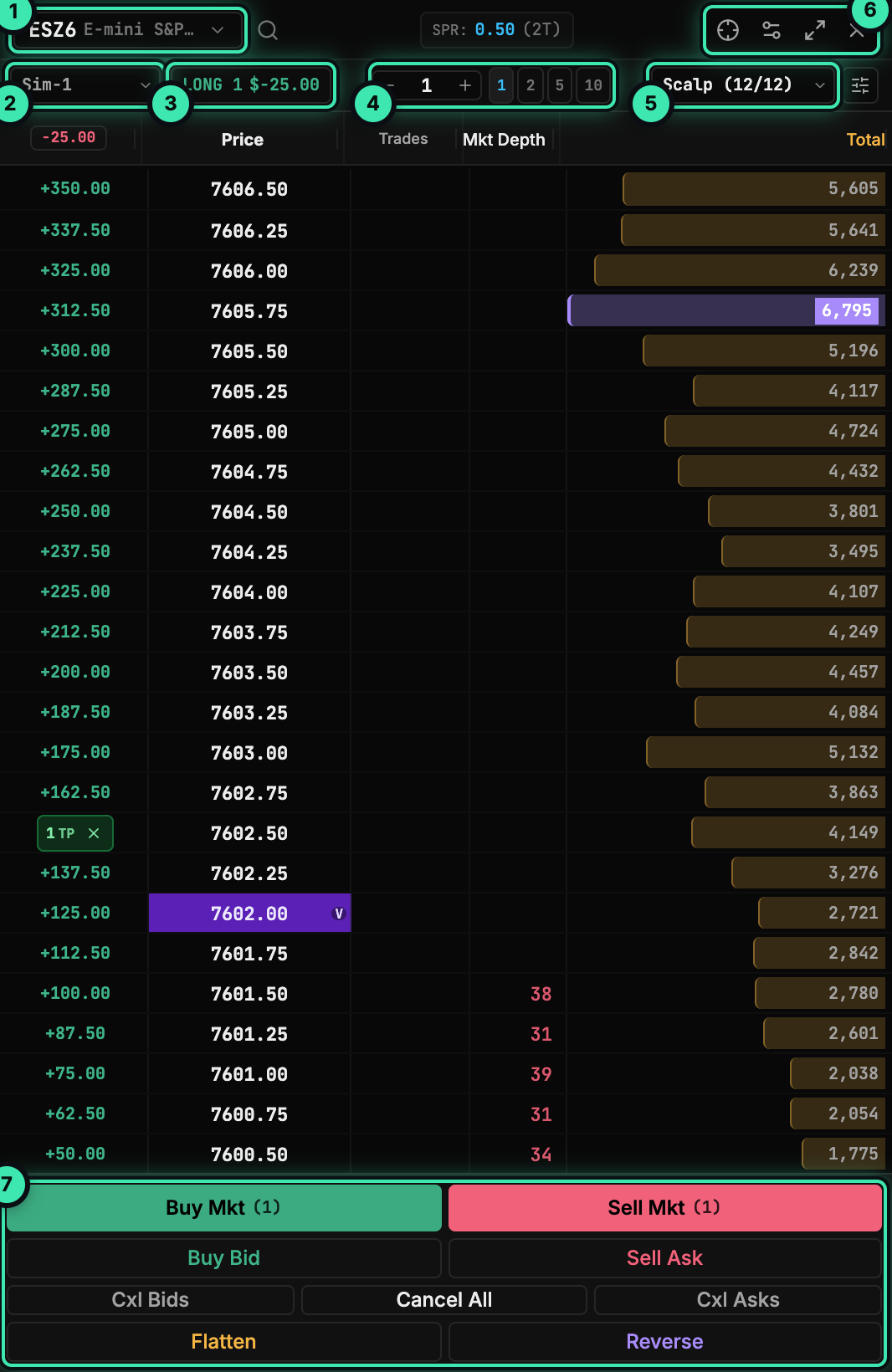
The DOM (depth of market), also called the price ladder, lists prices vertically with the resting bids and offers next to each price. Many futures traders place and manage orders directly on the ladder because it shows exactly where an order sits in relation to the market.
Charts
Charts show price over time. Day traders often use short time frames, such as 1 to 5 minutes, together with reference levels like the prior day’s high and low. Order flow traders add footprint charts and volume profile; see the order flow trading guide when you’re ready for that.
What order types do futures day traders use?
| Order | What it does | Main risk |
|---|---|---|
| Market | Fills right away at the best available price | Slippage in fast or thin markets |
| Limit | Fills at your price or better | May never fill |
| Stop (stop market) | Becomes a market order when price trades at your stop | Can fill well past your stop in a fast move |
| Stop-limit | Becomes a limit order when price reaches your stop | May not fill at all if price jumps past the limit |
| Bracket | Entry with an attached stop loss and profit target | Settings are only as good as your plan |
| OCO | Two linked orders; when one fills, the other cancels | Must check both legs are correct |
A bracket order is the most useful habit for a beginner. As soon as your entry fills, the platform places a protective stop and a target, linked so that when one fills, the other cancels (OCO). You never sit in a position without a stop because you forgot to place one.
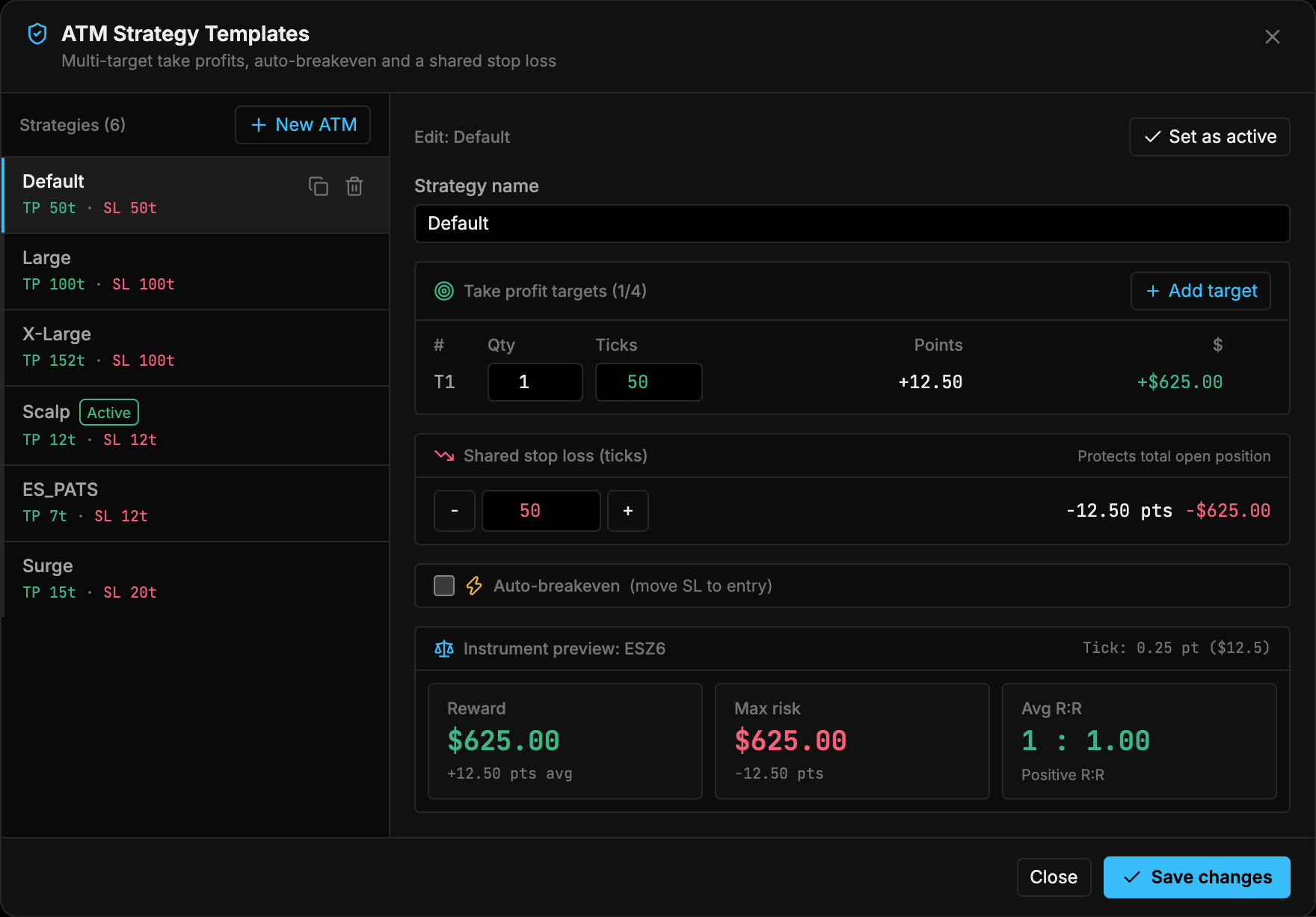
Stop orders protect you, but they don’t guarantee a price. In a fast market or at a news release, a stop market order can fill several ticks beyond your stop. Build that into your risk.
What does a simple day trading routine look like?
A routine keeps you from making decisions on the fly. Here’s a simple version many traders use.
Before the session
- Mark your levels. Note the prior day’s high, low and close, the overnight high and low, and any obvious levels from higher time frames.
- Check the economic calendar. Major US reports such as the jobs report and CPI come out at 8:30 a.m. ET (7:30 a.m. CT), and the Federal Reserve releases its rate decisions at 2:00 p.m. ET. Know what’s scheduled and whether you’ll be flat when it hits.
- Write a session plan. Which setups you’ll take, where you’d be wrong, your maximum loss for the day and the time you’ll stop trading.
During the session
- Trade only the setups in your plan, with a bracket on every trade.
- Track your running P&L against your daily loss limit.
- Stop when you hit your daily loss limit or your planned end time, whichever comes first.
After the session
- Close all positions before your broker’s day margin cutoff or your firm’s close rule.
- Log every trade in your journal (more on that below).
The equity index regular session runs from 8:30 a.m. to 3:00 p.m. CT, and the busiest stretch is usually the first hour after the open. Futures day trading strategies covers how traders approach the open, trend days and ranges.
How do you manage risk as a futures day trader?
Risk management decides how long you last. A good setup with oversized risk can still wipe out an account.
Risk per trade
Decide in advance the most you’ll lose on a single trade. Many traders express it as a fixed dollar amount or a small percentage of the account. The point is that one loss, or a run of losses, never does serious damage.
Daily loss limit
Set a hard daily stop: once your losses for the day reach a fixed amount, you stop trading. It protects you from the spiral of trying to win back losses. Prop firms often impose their own daily loss limit; set your personal one tighter than theirs.
Position sizing with tick value
Position sizing turns your risk limit into a number of contracts. The formula:
Contracts = risk per trade ÷ (stop distance in ticks × tick value)
Round down, never up. The stop distance comes from the setup, where the trade idea is clearly wrong, not from how much you want to make.
This is why micros matter for beginners: they let you size a trade to your risk limit instead of letting the contract size decide your risk.
How should you practice before trading real money?
Simulator trading
A simulator (paper trading) account lets you place orders on live market data without risking money. Use it to learn the platform, the order types and your routine until you make no mechanical mistakes. Simulated fills are usually better than real ones, especially for limit orders, so treat sim results as a best case.
Market replay
Market replay plays back a past trading day so you can trade it as if it were live. You can practice a specific situation, such as the open, a news release or a trend day, many times in an evening instead of waiting for it to happen.
Keep a trading journal
A trading journal records every trade: market, entry, exit, size, setup, the reason for the trade and how you felt. Review it weekly. Patterns show up quickly, such as losses that cluster after a certain time of day or trades you took outside your plan.
Move from sim to real money only when you’ve followed your plan consistently for weeks, not after a few good days.
What are the most common beginner mistakes?
- Trading too large. Using full-size contracts, or too many micros, so that a normal loss is a big loss.
- No stop, or moving the stop. Widening a stop to avoid taking a loss turns small losses into large ones.
- Revenge trading. Taking unplanned trades to win back a loss, which usually adds to it.
- Trading through news by accident. Holding a position into an 8:30 a.m. ET release without meaning to.
- Ignoring costs. Commissions, exchange fees and data fees add up quickly for active traders.
- Trading the wrong contract month after the roll.
- Holding past the cutoff. Missing the broker’s day margin cutoff or a prop firm’s close rule.
- Hopping between markets and methods before learning one properly.
- Skipping the journal, so the same mistakes repeat.
Putting it together
A practical path into futures day trading looks like this:
- Pick one market, often a micro such as MES or MNQ, and learn its specs and hours.
- Decide between a broker account and a prop firm evaluation, and read every rule and fee.
- Set up a platform with the data you need and learn the DOM, charts and brackets.
- Write a routine with pre-market levels, a calendar check and a session plan.
- Fix your risk per trade and daily loss limit, and size every trade from tick value.
- Practice on sim and replay with a journal until you follow the plan without exceptions.
Start with the tick value cheat sheet and the trading hours guide, then read the prop firm guide if you’re considering an evaluation. Futures trading involves substantial risk of loss and isn’t suitable for everyone.
Frequently asked questions
How much money do you need to day trade futures?
There's no single answer. Your broker sets its own minimum deposit and day trading margin, and a prop firm evaluation has a fixed fee instead. What matters more is having enough capital that a normal losing streak, sized with a sensible risk per trade, doesn't end your account.
Can you lose more than you deposit trading futures?
Yes. Futures are leveraged, and a fast move or a gap can take a position past your stop. With a retail broker you're responsible for any negative balance, which is why the standard futures risk disclosure warns that losses can exceed the funds you deposit.
What is the best futures contract for beginners?
We don't recommend specific markets. Many beginners start with micro contracts such as MES or MNQ because each tick is worth 1/10th of the full-size E-mini, so mistakes cost less while they learn.
Should I start with a broker account or a prop firm evaluation?
It depends on your goals and budget. A broker account trades your own money with no third-party rules, while an evaluation caps your cost at the fee but adds drawdown and daily loss rules you must follow. Read the full rules of either before you start.
Sources
- CME Group: E-mini S&P 500 futures contract specs
- CME Group: Micro E-mini S&P 500 futures contract specs
- CME Group: E-mini Nasdaq-100 futures contract specs
- CME Group: Micro E-mini Nasdaq-100 futures contract specs
- CME Group: Light Sweet Crude Oil (WTI) futures contract specs
- CME Group: Micro WTI Crude Oil futures contract specs
- CME Group: Gold futures contract specs
- CME Group: Micro Gold futures contract specs
- CME Group: Contract month codes
- CME Group: Trading hours
- CME Group Education: Margin, know what's needed
- eCFR: 17 CFR 1.55, risk disclosure statement for futures customers
- U.S. Bureau of Labor Statistics: Release calendar
- Federal Reserve: FOMC meeting calendars and statements