How to Manage Multiple Prop Firm Accounts
How to manage multiple prop firm accounts: firm rules to check first, how trade copiers mirror orders, sizing and symbol mapping, and per-account risk limits.
By TickMint Team Published 7 min read Intermediate
Key takeaways
- Before opening a second account, check your firm's account cap, whether copiers are allowed and whether all accounts must belong to you.
- A trade copier mirrors a lead account's orders to follower accounts, scaled by a multiplier or a fixed size.
- Copied accounts can drift out of sync through rejections, partial fills or disconnects, so decide in advance what should happen when they do.
- Each account needs its own limits, because accounts sit at different distances from their drawdown thresholds.
- Copying multiplies one decision across every account, so a single bad trade hits all of them at once.
On this page
- Why do traders run several prop firm accounts?
- Which firm rules should you check first?
- How does a trade copier work?
- Order mirroring vs fill mirroring
- Sizing ratios
- Symbol mapping
- Latency and partial fills
- Desync and disconnects
- How should you set risk limits for each account?
- What are the downsides of copying trades across accounts?
- How do you keep multiple accounts organized?
- Name accounts clearly
- Track each account’s drawdown
- Journal the lead, note the followers
- Putting it together
To manage multiple prop firm accounts, first confirm that your firm allows several accounts and copy trading, then decide how orders get to each account: manually or through a trade copier. Give every account its own size and risk limits, track each account’s drawdown separately and keep a clear naming and journaling system. Remember the main downside: copied accounts take the same trades, so one bad trade hits all of them.
This guide covers the firm rules to check, how copiers work, the risks and a simple workflow. If you’re new to prop firms, start with the futures prop firm trading guide.
Why do traders run several prop firm accounts?
Traders add accounts for a few common reasons:
- More capital on the same trades. Several smaller accounts can add up to more buying power than one.
- A buffer against one failure. If one account fails its drawdown, others may still be open, although copied accounts often fail together. More on that below.
- Staggered phases. One account can be in an evaluation while others are already a funded account working toward a payout.
- Different rule sets. Accounts at different firms or sizes can have different drawdown types and limits.
More accounts also means more fees, more rules to track and more ways for something to go wrong. It’s an operational choice, not a shortcut.
Which firm rules should you check first?
Read your firm’s current rules before opening a second account. These are the points that most often trip traders up. They vary by firm, so treat this as a checklist rather than a description of any one firm.
| Rule | What to look for |
|---|---|
| Maximum number of accounts | Many firms cap how many evaluations or funded accounts one person can hold at a time. The cap may differ for evaluations and funded accounts. |
| Trade copiers | Some firms allow copiers between accounts you own, some restrict which tools you can use and some prohibit copying entirely. |
| Account ownership | Copying trades between accounts owned by different people is commonly prohibited. So is sharing signals or managing someone else’s account. |
| Opposite positions | Being long in one account and short in another at the same time is often treated as hedging and banned. |
| Automated trading | Some firms treat a copier as automation and have separate rules for it. |
If the rules page is unclear, ask the firm in writing and keep the answer. Rules change, so check again when you open new accounts.
How does a trade copier work?
A trade copier watches one account, the lead, and repeats its activity on one or more follower accounts. You trade the lead as usual, and the copier places matching orders on each follower.
Order mirroring vs fill mirroring
Copiers handle orders in one of two broad ways.
| Approach | How it works | Trade-off |
|---|---|---|
| Order mirroring | Each order the lead places, such as a limit, stop or market order, is placed on followers too. Modifications and cancels are copied as well. | Followers work the same prices, but a limit order may fill on the lead and not on a follower, or fill at a different time. |
| Fill mirroring | The copier waits for the lead to be filled, then sends orders to the followers, often as market orders. | Followers almost always get in, but a moment later, so they can take slippage the lead didn’t. |
Neither approach makes followers identical to the lead. Each follower account gets its own fills from the market.
Sizing ratios
Each follower needs a size rule. The two common options are:
- Multiplier: the follower trades a ratio of the lead’s size, such as 0.5× or 2×.
- Fixed quantity: the follower always trades a set number of contracts, whatever the lead trades.
Watch rounding with multipliers. At 0.5×, a 3-contract lead order becomes 1.5 contracts, which a copier must round to 1 or 2. A 1-contract lead order may round down to 0 and not be copied at all.
Symbol mapping
Symbol mapping lets a follower trade a different product from the lead. A common case is mapping NQ (E-mini Nasdaq-100) to MNQ (Micro E-mini Nasdaq-100) so a smaller account can follow a larger one with micro contracts.
Check each follower’s dollar risk per trade, not just its contract count. The tick math is covered in futures tick size and tick value.
Latency and partial fills
Every copied order takes time: the lead’s update has to arrive, the copier has to react, and the follower’s order has to reach the exchange. In a fast market, that gap can mean a worse price.
Partial fills add another wrinkle. If the lead’s 4-contract limit order fills 2 contracts and the price leaves, followers may be filled for more, fewer or none. Your accounts now hold different positions for the same trade.
Desync and disconnects
A follower is out of sync when its position doesn’t match the scaled lead position. Common causes:
- an order rejected on the follower, for example for a size limit or a closed account;
- a partial fill or a limit order that filled on one side only;
- a manual trade placed directly on one account;
- a dropped connection to one follower.
On a disconnect, orders sent while the follower is offline don’t reach it. It might stay flat while the lead enters, or worse, stay in a position after the lead exits. Whether its stop is still working depends on whether the bracket order was held at the broker or only by the software.
Decide in advance what should happen on a desync. Copiers typically offer some mix of flattening the follower, disabling it and alerting you. Flattening and pausing the follower is the more conservative choice, because it stops the follower trading without the lead’s management.
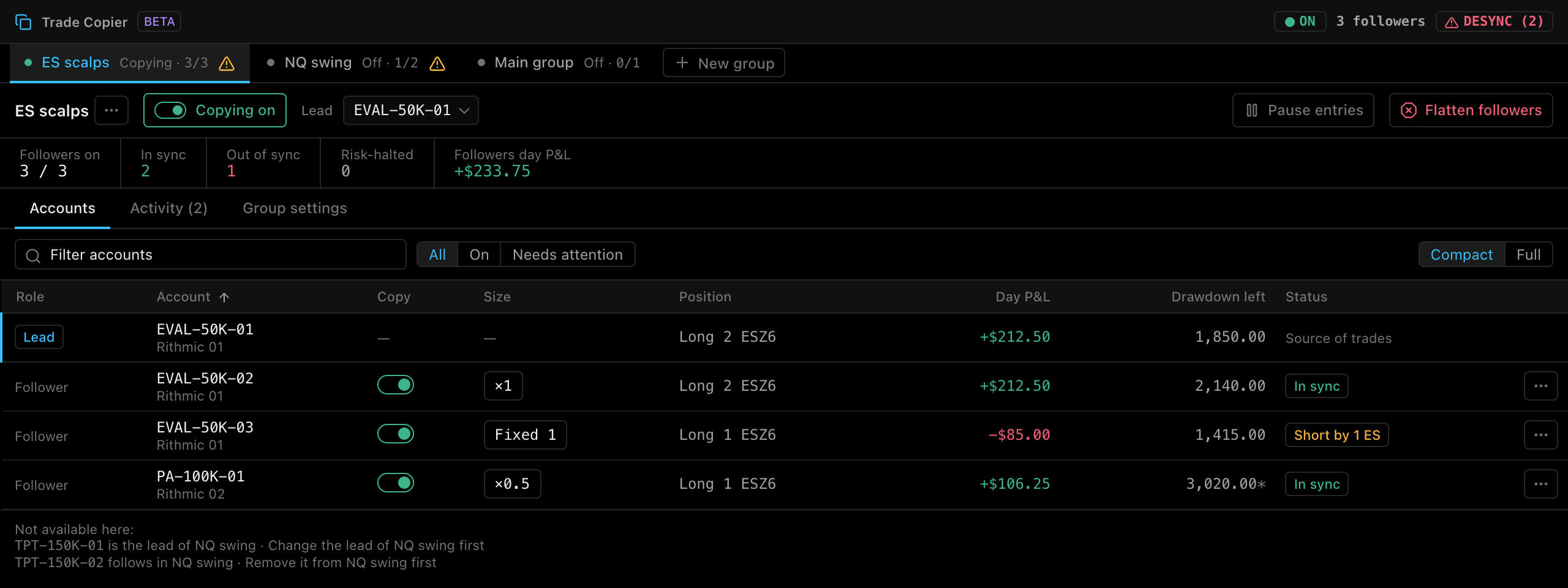
TickMint’s Trade Copier uses this lead and follower model and offers per-follower daily loss, drawdown buffer and max position limits, plus a choice of flattening, disabling or alerting when a follower falls out of sync. You can run several copier groups, and an emergency Flatten all button turns every group off and flattens every account.
How should you set risk limits for each account?
Every account needs its own limits, even when they all copy one lead. The reason is that accounts drift apart. One may be $2,400 from its liquidation threshold, another $900, depending on when you opened it and how its trailing drawdown has moved.
For each account, set:
- A daily loss stop below the firm’s daily loss limit, so the copier or your own rule halts new entries first. See prop firm consistency rules and daily loss limits.
- A drawdown buffer, a cushion above the liquidation threshold where new entries stop.
- A max position at or below the firm’s contract limit for that account.
- Size based on the remaining buffer, so the account closest to its threshold trades the smallest size.
How drawdown is measured changes these numbers. Read trailing vs EOD vs static drawdown for the differences.
What are the downsides of copying trades across accounts?
The biggest downside is correlated risk. Copied accounts aren’t diversified. They take the same trade at the same moment.
Suppose you copy one lead to five accounts, each with $1,500 of drawdown left, and every account loses $600 on a bad trade. You haven’t lost $600, you’ve lost $3,000 across your accounts. Two more trades like it and all five could fail on the same day.
Other downsides:
- Fees multiply. Evaluation, activation and data fees scale with account count.
- Rule mistakes multiply. Breaking a news or size rule on the lead can break it everywhere.
- Emotional pressure. Watching five losses at once can push traders toward revenge trades or moving stops.
Some traders keep follower sizes smaller than the lead, or keep the riskiest accounts off the copier until they have more buffer.
How do you keep multiple accounts organized?
A simple, repeatable workflow beats memory.
Name accounts clearly
Use one naming pattern for every account, such as firm, size, phase and number: F1-50K-EVAL-03 or F2-100K-FUND-01. Use the same name in your platform, spreadsheet and journal.
Track each account’s drawdown
Keep one row per account with:
| Field | Why |
|---|---|
| Starting balance and drawdown type | Sets how the threshold moves |
| Current liquidation threshold and buffer | Shows how close each account is to failing |
| Daily loss limit and reset time | Stops you trading through it |
| Consistency status | Shows whether you’re eligible to pass or request a payout |
| Payout dates, fees and renewals | Keeps costs visible |
Update it at the end of every session, after the firm’s daily reset.
Journal the lead, note the followers
A trading journal entry per trade on the lead is usually enough for reviewing decisions. For followers, note only what differed: slippage, clipped sizes, rejections and desyncs. Patterns in those notes show where your setup needs work.
Putting it together
- Read each firm’s rules on account caps, copiers, ownership and hedging.
- Choose a lead and set each follower’s size and symbol mapping by dollar risk.
- Set per-account daily stops, drawdown buffers and max positions.
- Decide what happens on a desync before you go live, and test with small sizes.
- Track every account’s buffer daily and journal follower deviations.
Frequently asked questions
Are trade copiers allowed by prop firms?
Some firms allow copying between accounts you own, some restrict it and some prohibit it. Copying trades to or from accounts owned by other people is commonly prohibited. Check your firm's current rules before you connect a copier.
What is the difference between order mirroring and fill mirroring?
Order mirroring copies each order the lead places, including limit and stop orders, so followers work the same orders. Fill mirroring waits for the lead to be filled, then sends orders to the followers, which gets them in but at a slightly later price.
How do I copy NQ trades to MNQ accounts?
Use the copier's symbol mapping to map NQ to MNQ, then set the size. One MNQ tick is worth $0.50 and one NQ tick is worth $5.00, so 10 MNQ contracts match the dollar exposure of 1 NQ contract.
What happens if a follower account disconnects?
Orders sent while it is offline don't reach it, so it can end up flat, or in a position without the lead's later exits. Many copiers flag this as a desync and can flatten or disable that follower, depending on how you configure them.
Does running more accounts reduce risk?
Not when the accounts are copied. Every account takes the same trade, so a loss lands on all of them at once. Copying multiplies your exposure to each decision rather than spreading it out.